Your tracking deck has no lock on it
TL;DR
- Research on unreleased titles is some of the most sensitive material a studio produces. That means tracking, screening results, concept tests and release plans. Most of it still goes out as email attachments.
- An attachment has no lock. Once it’s sent, you can’t see who has it, can’t limit who opens it and can’t take it back.
- The old leak risk now has new pressure on top. Studios are adding insider-information rules as prediction markets take bets on movie news and release dates.
- You don’t need a security overhaul. You need three tiers of sensitivity, handling rules for each, and a delivery method that keeps control after you hit send.
- There’s a 30-minute audit at the end. Run it on your last tracking deck today.
The forward chain
Here’s how a screening report travels at a lot of studios.
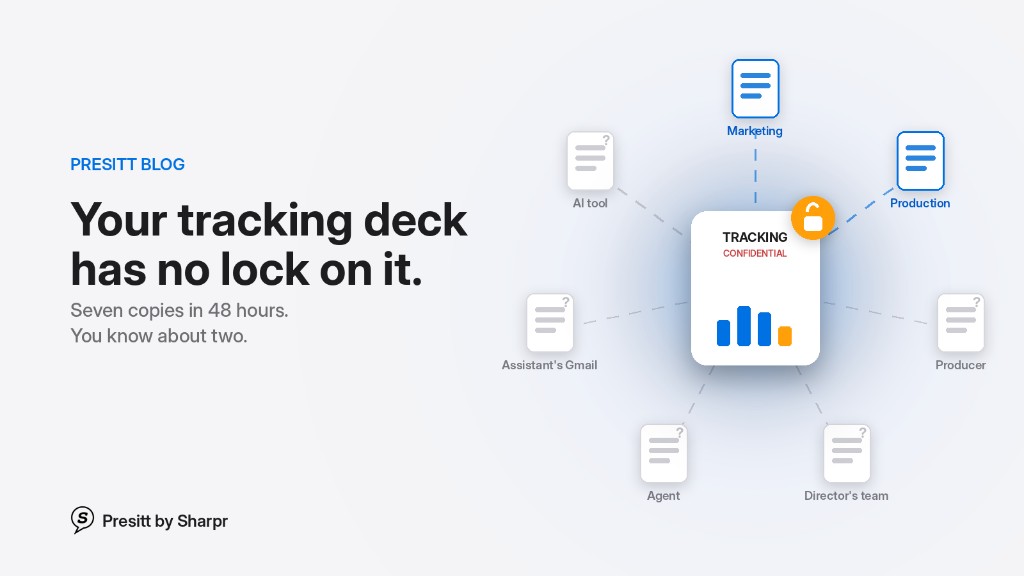
The vendor emails it to the research lead. The research lead forwards it to the head of marketing and the production exec. The production exec forwards it to the producer. The producer forwards it to the director’s team and an agent. Somebody’s assistant saves it to a personal drive to read on the weekend. Somebody else drops it into an AI tool to summarize it.
That’s seven copies in 48 hours. The research lead knows about two of them.
Nobody in that chain did anything wrong by their own standards. Forwarding is how work gets done. The problem is the format. An attachment is built to be copied, and every copy is permanent.
Now multiply that by every tracking update, concept test and screening on every title in a year.
Why this got more urgent
Leaks of screening results and tracking aren’t new. Trade reporters have been getting test screening scores for as long as there have been test screenings. Studios have long treated release dates and campaign plans as guarded.
What’s new is a direct financial incentive. Studios and media companies are introducing insider-information restrictions as prediction markets take bets on movie news and release dates. When information about an unreleased title can be traded, the research that predicts how that title will perform becomes more valuable to people outside the building.
You don’t need to believe anyone on your team would misuse it. You need to be able to answer a simple question if compliance asks: who had access to this, and when?
Most research teams can’t answer that for anything they sent as an attachment.
What’s actually sensitive
Not everything needs the same protection. Treating every deck like a state secret just means people route around the rules. Start by sorting.
Tier 1: Restricted
Material that would move markets, damage a release or damage talent relationships if it leaked.
- Tracking on unreleased titles
- Recruited screening scores and verbatims
- Release date plans before announcement
- Research involving unannounced projects or talent
- Anything covered by platform or deal confidentiality terms
Tier 2: Confidential
Internal material that shouldn’t leave the company but wouldn’t cause serious damage if it did.
- Post-release readouts
- Campaign performance research
- Genre and audience studies
- Competitive analyses
Tier 3: Internal
Material that’s fine to share broadly inside the company.
- Published industry data summaries
- Methodology guides
- Training material
Most studio research teams will find that a big share of what they send is Tier 1. That’s the point. The most sensitive material is also the most frequently shared, because it’s what everyone wants to see before the big meetings.
Handling rules by tier
Write these down. One page. Pin it where the team works.
| Tier 1: Restricted | Tier 2: Confidential | Tier 3: Internal | |
|---|---|---|---|
| Delivery | Link only, never attachment | Link preferred | Any |
| Recipients | Named individuals only | Named people or defined teams | Anyone internal |
| Download | Off by default | On if needed | On |
| Expiry | Set, tied to release or decision date | Optional | None |
| Forwarding | Recipients can’t add people | Allowed internally | Allowed |
| Access record | Required | Recommended | Not needed |
| External parties (filmmakers, reps, agencies) | View-only, separate link per party | Case by case | Yes |
The single most important line is the first one. Tier 1 never goes as an attachment. Everything else follows from that.
Different recipients, different rules
The people who see studio research don’t all have the same relationship to it. Handle them differently.
Studio executives. They need fast access, often on a phone, often in a car. Make it easy: one link, opens on mobile, no login maze. But keep it named. If the chairman’s assistant needs access, add the assistant by name rather than letting the link float.
Filmmakers. Screening results are personal for filmmakers. The studio usually wants to frame them, not hand over raw scores. Send a version prepared for them, view-only, on its own link. That way the full deck with the exec commentary doesn’t reach them by accident.
Talent reps and agents. This is where the most damaging leaks start. If reps need to see anything, send a specific, limited version with its own access record. Never forward the internal deck.
Agencies. Trailer houses and campaign agencies often need research to do their jobs. Give them what’s relevant to their brief, on a link that expires when the campaign phase ends.
Vendors. The research vendor created the work, but that doesn’t mean they need ongoing access to your commentary on it. Keep the studio’s internal analysis separate from the vendor’s original report.
Former employees. The quietest leak of all. When someone leaves, every attachment they ever received leaves with them. With links, you can turn off their access the day they go.
The controls that matter, in order
If you can only do some of these, do them in this order.
- Links instead of files. This is the foundation. A link means the document stays somewhere you control, and you can change who sees it after it’s sent. Everything else depends on this.
- Named recipients. A link that anyone can open is barely better than an attachment. Tie access to specific people.
- An access record. Who opened it, when, and from where. You need this to answer the compliance question, and it’s also how you know whether the decision owner saw it before the meeting.
- Revocation. The ability to switch off access for one person or everyone. You’ll need it when someone leaves, when a deal falls through or when a document gets forwarded where it shouldn’t.
- Expiry. Tracking from six months ago is still sensitive, but nobody needs it on their phone. Tie expiry to the release date or the decision date.
- View-only. Turn off downloads for Tier 1. Most people only need to read it.
- Watermarking, if your tool supports it. A visible name on every page discourages screenshots and identifies the source if one surfaces.
What controls can’t do
Be honest with yourself here. No delivery tool stops someone from taking a photo of their screen with their phone. Nothing stops a person from reading a number out loud on a call.
Controls don’t make leaks impossible. They do three things:
- They cut the casual leaks, which are most leaks. The forward to an agent, the copy in a personal drive, the attachment sitting in an ex-employee’s inbox.
- They give you a record, so when something surfaces you know who had access.
- They change behavior. People handle a named, tracked link more carefully than an attachment.
That’s a big improvement over the current state, where the honest answer to “who has this?” is “no idea.”
The AI tool problem
One vector most teams haven’t thought about yet: people uploading research to AI tools to summarize it.
It’s a reasonable thing to want. A 60-page screening report is long, and an exec wants the three points that matter. But a Tier 1 document uploaded to a consumer AI tool may sit outside the studio’s control, under someone else’s terms.
Two fixes:
- Give people the summary they want, so they don’t need to make their own. A clear one-page summary at the top of every Tier 1 report removes most of the reason to upload it.
- Check your company’s approved tools policy and make sure the research team knows which AI tools are cleared for confidential material.
When something leaks anyway
It will happen eventually. Have the playbook ready before it does.
Hour 1: Contain. Revoke access on the link that leaked. If the source isn’t obvious, revoke all external access on that document and reissue to people who still need it.
Hour 2: Check the record. Who had access? Who opened it, and when? Compare the access list to the timing of the leak.
Hour 3: Tell the right people. Legal and compliance, the exec who owns the title and whoever manages the talent relationship. Keep it factual: what leaked, when, who had access.
Day 2: Fix the gap. Was the leak through a forward, a download, a screenshot, a departed employee? Tighten the specific control that failed. Don’t respond by locking down everything. That just pushes people back to attachments.
Week 2: Review. Was the document tiered right? Did the recipients need it? Update the handling rules if they were wrong.
The access record is what makes hours one through three possible. Without it, you’re guessing.
Vendors: this is your problem too
If you’re a screening, tracking or trailer-testing vendor, your studio clients’ confidentiality is part of what they’re buying.
When you send a Tier 1 report as an attachment, it’s out of your hands and theirs. If it leaks, the first question will be where it came from. You’re in a strong position if you can show exactly who you sent it to, who opened it, and that it was view-only with an expiry date.
It’s also a selling point. “We deliver every report as a controlled link with an access record” is a sentence studio research leads want to hear from vendors.
The 30-minute audit
Run this on the last tracking deck or screening report your team sent. Be honest.
- How was it sent? Attachment or link?
- Who was it sent to? List every name.
- Who has it now? Ask the recipients if they forwarded it. Write down the answers.
- Who opened it? Can you tell?
- Could you revoke access right now? For anyone? For everyone?
- Does anyone who’s left the company still have a copy?
- Was a version for the filmmakers or reps sent separately, or did they get the internal deck?
- Did anyone upload it to an AI tool?
Score one point for each question you can answer with confidence.
- 7 to 8: You’re in good shape. Write down your process so it survives team changes.
- 4 to 6: You know where the gaps are. Start with links and named recipients.
- 0 to 3: Most studios are here. That’s the honest starting point. Pick the next Tier 1 send and do it differently.
Start with the next send
You don’t need a policy committee or a six-month rollout. You need to change how the next Tier 1 document goes out.
- Send it as a link, not an attachment
- Name every recipient
- Turn off downloads
- Set an expiry tied to the decision date
- Check the access record before the meeting
Do that once. Then do it for the next one. In a month it’s how your team works.
The research on unreleased titles is too valuable to protect with nothing more than a subject line that says CONFIDENTIAL.
Presitt sends research as controlled links: named recipients, view-only, expiry, revocation and an access record for every reader.
Want help setting up the whole delivery process for your team? Email me at joey.stawiarski@sharpr.com.
Questions people ask
How should a film studio share confidential documents securely?
Sort research into three tiers: restricted, confidential and internal. Restricted material, like tracking on unreleased titles, screening scores and release plans, goes out only as a link, never as an attachment. Send it to named people with downloads off, an expiry date and an access record, so you can see who opened it and switch off access later.
Why are email attachments risky for tracking and screening reports?
An attachment has no lock. Once it's sent you can't see who has it, can't limit who opens it and can't take it back. Every forward makes a permanent copy. Reports also get saved to personal drives, dropped into AI tools and kept by people who leave the company.
What studio research counts as restricted?
Anything that could move markets, damage a release or hurt talent relationships if it leaked. That includes tracking on unreleased titles, recruited screening scores and verbatims, release date plans before they're announced, research on unannounced projects or talent, and anything covered by platform or deal confidentiality terms.
Can secure sharing tools stop leaks completely?
No. Nothing stops someone photographing a screen or reading a number aloud on a call. Controls cut the casual leaks, which are most leaks. They give you a record of who had access, and people handle a named, tracked link more carefully than an attachment.
What should a studio do when screening results leak?
In the first hour, revoke access on the link that leaked. In the second, check the access record against the timing of the leak. In the third, tell legal, compliance, the exec who owns the title and whoever manages the talent relationship. On day two, fix the control that failed. In week two, check whether the document was tiered correctly.