From tracking to the dating meeting: get it read before the room
TL;DR
- Tracking is built to move decisions: dating, spend, campaign shifts. It only does that if the people making those decisions read it before they walk in.
- Most tracking updates are on time for the research calendar and late for the decision calendar. They land the night before and get read in the car.
- The fix is to plan the send backwards from the meeting: which decision, who owns it, what they need on page one, and the last moment it can still change anything.
- Then send each reader the version they actually need. Same study, different first page.
- Below: what tracking measures and what it doesn’t, a map of the slate, how to read movement instead of snapshots, page-one templates by role, a send schedule, and what to do when the number moves late.
Thursday, 9pm
Here’s a week most studio research teams will recognize.
The tracking update arrives Thursday evening. It shows awareness up after the new trailer, but interest flat, and first choice soft with one quadrant the campaign was built around. It’s a meaningful read. It might be the most important thing anyone sees before Friday.
The dating meeting is Friday at 10.
The research lead turns the update around fast, writes a clean summary and sends it at 9:15pm to a distribution list of 14 people. By 10am, a few people have read it properly. A few skimmed it on their phone. A couple opened it in the elevator. The person who owns the dating decision read the subject line.
Nobody was late. The vendor delivered on schedule. The research team turned it around the same night. And the most important finding of the week still didn’t shape the conversation, because it arrived as homework for a meeting that had already started in everyone’s head.
That isn’t a research problem. It’s a delivery problem. And it’s fixable.
What a box office tracking report actually measures
Before talking about delivery, it helps to be precise about what’s being delivered.
Pre-release tracking has been part of how studios plan releases since the 1980s. Tracking firms poll prospective moviegoers ahead of release and build their reads around three core measures:
- Awareness. Has this person heard of the movie? Usually split into unaided (they name it without prompting) and aided (they recognize it from a list). Total awareness combines the two.
- Interest. Do they want to see it? “Definite interest” is the measure most studios watch.
- First choice. From a list of upcoming movies, which one would they pick first? This one sits closest to opening weekend behavior.
All three get broken out by audience group, usually the four quadrants of men and women over and under 25.
Studios get tracking from more than one source. National Research Group’s three-week tracking has long been the industry standard. The Quorum publishes longer-lead tracking, often six weeks or more out, and surveys more than 2,000 people a week. Screen Engine/ASI is another major provider. Most studios combine several sources with their own internal reads.
The timing matters for this post. Tracking reads arrive over a window of a few weeks to a couple of months before release, on a weekly or more frequent rhythm. That means tracking is not one report. It’s a series, and every new update lands into a week that already has decisions scheduled in it.
What tracking isn’t
Tracking isn’t a verdict. It’s a read on where the audience is today, and a projection of where it might be on opening weekend.
It’s been wrong in both directions, and every studio research lead has a story about a movie that tracked soft and opened big, or tracked big and opened soft. That doesn’t make it useless. It makes it something that needs context: what changed since last week, which quadrant is moving, how this compares to comparable titles at the same point before release.
The practical takeaway: tracking only helps if the people making decisions read it with that context. A projected opening range in a subject line, with no trend and no quadrant split, invites exactly the wrong kind of certainty.
The slate sets the deadline
Studio research doesn’t really have a deadline of its own. It has the deadlines of the decisions it feeds.
Here’s a working map. Every studio runs it differently, but the shape is close.
| Decision | What research feeds it | Usually owned by | What they need first | Last useful moment |
|---|---|---|---|---|
| Greenlight | Concept tests, comps, prior franchise research | Studio and production leadership | Who it’s for, how comparable titles performed, the main risk | Before the greenlight memo is final |
| Cut lock | Recruited screenings | Production, filmmakers | What’s working, what isn’t, by scene and quadrant | Before the last edit window closes |
| Dating | Long-lead tracking, comps, competitive calendar | Distribution | Tracking range, trend, competitive titles, quadrant overlap | Before the date is announced or shifted |
| Spend | Tracking, screenings, trailer tests | Marketing and finance | Where the audience is soft, what it would take to move it | Before media is locked |
| Campaign shifts | Weekly tracking, trailer and spot tests | Marketing | Which quadrant is moving, which isn’t, why | Before the next creative goes out |
| Home entertainment | Theatrical performance, exit polling, post-release research | Home entertainment marketing | Who actually showed up, what they said | Before the home entertainment campaign is set |
The right-hand column is the one that matters. That’s the real deadline. The vendor’s delivery date and your internal turnaround are just steps on the way there.
Rival Technologies’ published account of its work with Warner Bros. Discovery describes exactly this kind of constraint: a narrow window to apply theatrical feedback to home entertainment marketing. Miss that window and the finding is still correct. It just can’t change anything anymore.
The four questions before every send
Before any tracking update or screening result goes out, answer four questions. Write the answers down. They take two minutes and they change how the send works.
1. Which meeting does this feed?
Not “it’s the weekly tracking.” Which decision is it for? The Friday dating discussion? The spend review next Tuesday? A campaign call on the second trailer? If the answer is “none this week,” that’s useful too. It means the update can go out as a normal read without a push.
2. Who owns that call?
One name, not a distribution list. The person who will actually make or defend the decision. If you don’t know who that is, find out before you send. A beautifully written update that the decision owner never opens did nothing.
3. What do they need on page one?
Not what the research team finds most interesting. What the decision owner needs to make the call. For a dating decision, that’s probably the range, the trend and the competitive picture. For a spend decision, it’s where the audience is soft and whether it’s movable.
4. What’s the last moment it can still move the plan?
Work backwards from the meeting. If the decision owner needs to read it, think about it and maybe ask a question, the real deadline is probably the afternoon before, not the night before. That’s the time you’re actually working toward.
Read the movement, not the snapshot
A single tracking number is a snapshot. Decisions get made on movement.
The most useful thing a tracking send can do is show what changed, and why it might have changed. Three patterns come up again and again.
Awareness up, interest flat. The campaign is reaching people but not convincing them. This is the pattern where marketing usually wants to know first.
There’s a live example from this summer. CosmicBook News, reporting on Quorum tracking published by Puck, said Coyote vs. Acme went from 27% awareness and 41% interest in early August to 40% awareness and 43% interest three days before its August 28 opening. Thirteen points of awareness, two points of interest. That’s exactly the shape a dating or spend conversation needs to see as a trend, not two separate numbers on two separate days.
First choice strong in one quadrant, soft in another. Deadline’s coverage of Kingdom of the Planet of the Apes tracking noted unaided awareness was strong with men over and under 25, but first choice was a bit stronger with men under 25. That kind of split is what tells marketing where the next dollar goes.
Tracking moving after a creative event. A new trailer, a Super Bowl spot, a festival premiere, a review embargo lifting. Tracking that moves after a known event is telling you whether the event worked. Label the event in the send.
The rule: every tracking send should show at least the last three reads side by side, with the change, and any creative event that happened in between. A number without its trend is an invitation to over-read it.
Same study, different page one
One tracking update serves several people who need different things from it. Sending everyone the same deck means each person has to dig for their part, and most won’t.
Build the update once. Give each reader their own first page.
Distribution
- Opening range, with source and lead time (three-week, six-week)
- Trend over the last three reads
- Competitive titles opening the same or adjacent weekends, and their tracking
- Quadrant overlap with competition
- What would have to change for the date to be reconsidered
Marketing
- Awareness and interest by quadrant, with the trend
- First choice by quadrant
- The soft quadrant and the gap that matters most (usually awareness versus interest)
- What creative went out since the last read
- What tracking says about whether it worked
Filmmakers
For screening results, and for tracking when the studio chooses to share it:
- What’s landing with audiences, in their words
- Which audiences are most excited
- Framed for what’s useful creatively, not as a scorecard
Leadership
- The range, the trend and one sentence on what it means
- The main risk
- What decision this feeds and when
Finance
- Range and confidence
- How it compares to the plan the budget was built on
- What spend changes are on the table
Same data underneath. Five first pages. The full update sits behind every one of them for anyone who wants it.
This also solves a quieter problem: who should see what. Not everyone needs every quadrant split or every competitive title. A role-based first page gives each person what they need without forwarding the full deck to people who don’t.
A send schedule that works backwards from the meeting
Here’s a practical rhythm for a week with a Friday 10am dating meeting. Adjust the days for your calendar. The order matters more than the exact times.
Wednesday afternoon: confirm the decision. Check the meeting is still on, who owns the call and what the open questions are. Ask the decision owner directly: “What do you need from tracking for Friday?”
Thursday, when the update lands: write page one first. Before polishing the full deck, write the one-page version for the decision owner. Range, trend, quadrant split, competitive picture, one sentence on what it means.
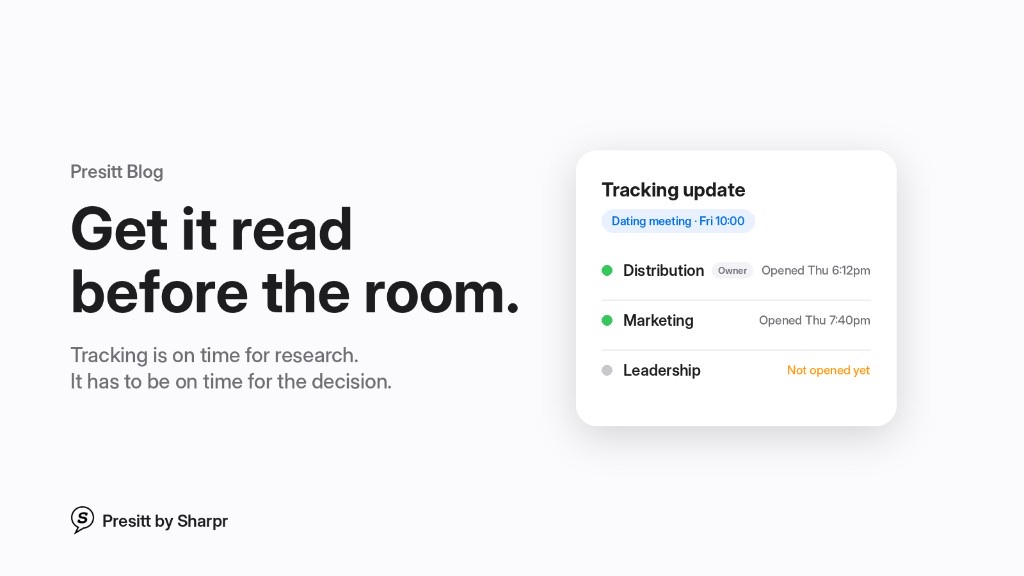
Thursday, before end of day: send page one to the decision owner. Not the full distribution list. Just them, plus anyone they’ve named. That gives them the evening to read it, not the elevator.
Thursday evening: send role versions. Distribution, marketing, leadership, finance. Each gets their own first page with the full update behind it.
Friday, 8am: check who’s opened it. If the decision owner hasn’t opened it, send a two-line nudge: “The thing that matters for 10am is on page one: interest is flat with women under 25 even after the new trailer.” Don’t resend the whole thing.
Friday, 9:30am: offer five minutes. If someone central still hasn’t seen it, offer a five-minute walk-through before the meeting, or ask for the first five minutes of the meeting.
After the meeting: write down what was decided. One line. Date held, date moved, spend shifted, campaign changed. That line becomes the record of what tracking actually did.
The difference between this and a 9:15pm blast isn’t more work. It’s the same work in a different order, aimed at the person who decides.
When the number moves late
Sometimes the update that matters arrives after the pre-read has already gone out. Tracking softens a day before the meeting. A competitive title moves onto your weekend. A trailer drops and interest jumps.
Have a rule for this before it happens.
Set a threshold. Agree in advance what counts as a material change: a move of a certain size in the opening range, a quadrant moving a certain amount, a competitive date shift. Below the threshold, it goes in the next normal update. Above it, it gets escalated.
Escalate by person, not by email. A material late change goes to the decision owner directly: a call, a message, a quick conversation. Then the written version follows. Don’t let a late change sit in an inbox the night before a dating decision.
Say what changed and what it means. “Tracking moved down overnight, mostly women under 25, probably the competitive release shifting onto our weekend. The range is now lower than what we discussed Wednesday.” One paragraph.
Record it. Note when the change arrived, who you told and when. If the post-mortem later asks whether research flagged it, you’ll have the answer.
What a good tracking send looks like
Here’s a page-one template for a tracking update. Copy it.
[Title]: tracking update, [date]
Feeds: [decision] on [date], owner [name]Range: [opening range], [source, lead time]
Trend (last three reads): [read 1] ? [read 2] ? [read 3]
Since last read: [creative event or competitive change]By quadrant: awareness / interest / first choice for M<25, M25+, F<25, F25+
Softest spot: [quadrant and measure]Competition: [titles on same/adjacent weekends and their tracking]
What it means: [one or two sentences, labeled as interpretation]
Main limit: [lead time, sample, a known blind spot]Full update: [link]
That’s a page. Everything else lives behind the link.
And here’s the two-line nudge for the morning of:
Quick one before 10am: the part that matters for dating is page one. Interest is flat with women under 25 even after Tuesday’s trailer, and [competitor] moved onto our weekend.
A worked week (illustrative)
This is made up, built to show the rhythm. Don’t read it as any real title.
A mid-budget action comedy is dated for late spring. A competitor’s sequel has just announced it’s moving to the same weekend. Distribution has a meeting Friday to decide whether to hold or shift.
The old way. Tracking lands Thursday night. It shows awareness up four points after a new trailer, interest flat, and first choice slipping with men under 25, the exact audience the competitor’s sequel is built for. The research lead sends the full deck to the usual list at 9pm. The head of distribution reads the range on her phone at 7am, sees it’s within the plan, and walks into the meeting leaning toward holding the date. The quadrant slip comes up 40 minutes in, when someone from marketing mentions it. By then the conversation has a direction.
The new way. Wednesday, the research lead asks the head of distribution what she needs for Friday. Answer: the range, whether the competitor overlap is real, and what moves if they hold. Thursday at 6pm, she gets one page: range with trend, the first-choice slip with men under 25, the competitor’s tracking with the same quadrant, and one labeled interpretation: the overlap is real and concentrated. Marketing gets its own page on the trailer and the flat interest. Friday at 8am, the record shows she’s opened it twice. No nudge needed.
The meeting starts with the overlap, not the range. The date moves two weeks. Same data. Different order.
Vendors: make your update easy to route
If you’re a tracking or screening vendor, how you deliver decides whether your work makes it into the room.
Three things help your studio clients:
- Lead with a one-page summary built around the trend and the quadrant split, not just the range.
- Label the lead time and sample on every number, so it can’t be forwarded without them.
- Ask which decision the update feeds this week. It shows you understand the client’s calendar, and it lets you flag what matters most.
Studios renew vendors whose work shows up in decisions. Make that easy.
How to tell if it’s working
Track three things for a month:
- Time to open. How long after sending does the decision owner open the update?
- Opened before the meeting. For each decision meeting, did the owner open the relevant update beforehand?
- Came up in the room. Did the tracking update get discussed, and did anything change because of it?
If the first two improve and the third starts showing up in your meeting notes, the send is doing its job.
Mistakes that keep tracking out of the room
The 9pm blast. Same report, same list, the night before. Technically on time. Practically unread.
The range in the subject line. “Tracking: $40-45M” gets forwarded and quoted without trend, quadrant or source. Put the range on page one, not in the subject.
One deck for everyone. Distribution digs for comps. Marketing digs for quadrants. Leadership doesn’t dig.
Snapshots without trend. A number with no history invites people to read too much into it.
No named decision owner. If the send is addressed to a list, nobody is accountable for reading it.
Treating late changes like normal updates. A material move the night before a dating meeting is a phone call, not a PDF.
Not knowing who opened it. If you can’t see whether the decision owner read the update, you can’t nudge them, and the post-mortem can’t tell whether tracking missed or nobody looked.
No record of what was decided. Without it, nobody can show later what tracking actually changed.
Before you hit send
Run this checklist every time.
- I know which decision this feeds and when
- I know who owns that decision, by name
- Page one is written for that person
- The trend shows at least the last three reads
- Any creative or competitive event since the last read is labeled
- Every number has its source and lead time
- Quadrant splits are on page one where they matter
- Role versions exist for distribution, marketing and leadership
- The decision owner gets it with time to read, not the night of
- I’ll know who opened it before the meeting
- I have a nudge ready if they haven’t
- I’ll record what was decided
The point
Tracking is one of the few pieces of research in a studio with a clear, recurring job: help decide when a movie opens, how much to spend and where to put the money. It’s built for decisions.
But a tracking update only does that job if the person making the decision reads it, with context, before the room fills up. Most of the time that’s not a research quality problem. The data is fine. The send is wrong: wrong time, wrong reader, wrong first page.
Plan the send backwards from the meeting. Give each reader the page they need. Know who opened it. Nudge the ones who didn’t.
The tracking was always on time. Now make it on time for the decision.
Presitt sends each tracking update as a link with a first page for each role, and shows you who opened it before the meeting.
Want the page-one templates as a ready-to-fill document? Email me at joey.stawiarski@sharpr.com and I’ll send them over.
Questions people ask
What is a box office tracking report?
A box office tracking report is a pre-release survey read on an upcoming movie, delivered to the studio weekly or more often in the weeks before release. It measures awareness (unaided, aided and total), interest (usually definite interest) and first choice, broken out by the four quadrants of men and women over and under 25. Many reports also include a projected opening range.
How far before release does box office tracking start?
It depends on the source. National Research Group's three-week tracking has long been the industry standard. The Quorum built its name on longer-lead tracking, often six weeks or more before release. Most studios combine several outside sources with their own internal reads, so tracking arrives as a series of updates, not a single report.
What's the difference between awareness, interest and first choice?
Awareness asks whether someone has heard of the movie. Interest asks whether they want to see it. First choice asks which movie, from a list of upcoming titles, they would pick first, and it sits closest to opening weekend behavior. The gap between them matters: awareness rising while interest stays flat usually means the campaign is reaching people without convincing them.
When should a tracking update be sent before a release dating meeting?
Work backwards from the meeting. If the decision owner needs to read it, think about it and maybe ask a question, the real deadline is usually the afternoon before, not the night before. Send the one-page version to the decision owner first, then the role versions, and check who has opened it on the morning of the meeting.
What should go on page one of a tracking update?
The decision it feeds and who owns it, the opening range with source and lead time, the trend over at least the last three reads, any creative or competitive event since the last read, the quadrant split, the competitive titles, one or two labeled sentences on what it means and the main limit. Everything else goes behind a link to the full update.