The test screening report: what should travel with the score
TL;DR
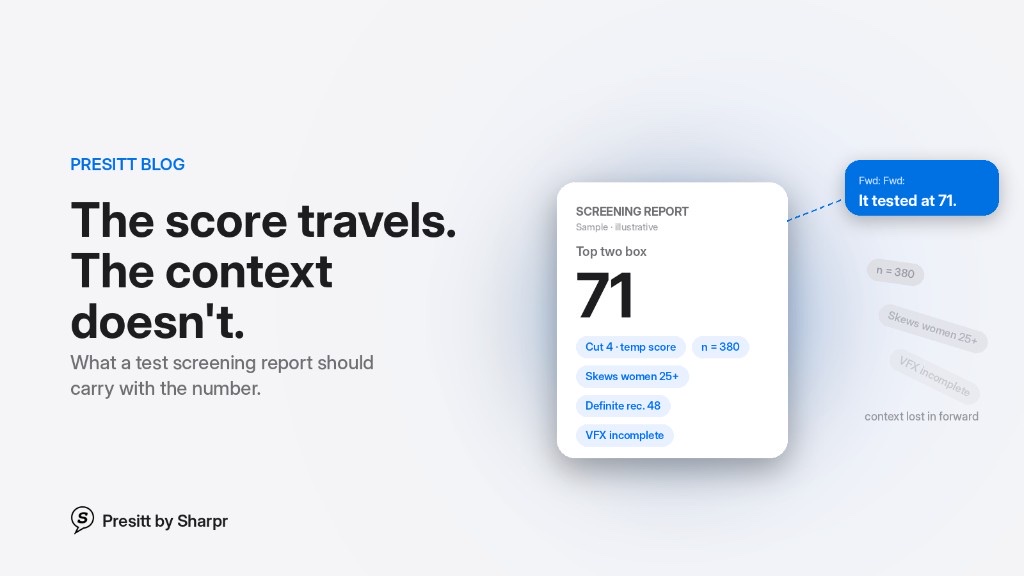
- A screening report gets forwarded. The score survives the trip. The context usually doesn’t.
- The fix isn’t a longer report. It’s a report built so the number can’t travel without the cut, the room, the gap, the limits and the decision it feeds.
- Below: what every block of a screening report should carry, how to read the two numbers everyone asks about, how to compare cuts without fooling yourself, three versions for three readers, and a fill-in template.
- If you only steal one thing, steal the cover line. One sentence, top of page one, that nobody can forward without.
The 11pm forward
Here’s a night most studio research people have lived through.
The screening ends around 10. The focus group wraps. The vendor’s analyst has the topline numbers on a laptop in the lobby. Somebody types the top-two-box score into a text to the head of marketing. The head of marketing forwards it to the chairman. By midnight, five people know the number. Nobody has seen who was in the room, which cut ran, or that the temp score was so unfinished it got laughs in the wrong place.
The full report shows up two days later, careful and properly caveated. By then the number has already done its work. Somebody has decided the movie “tested great” or “has problems,” and the 40-page deck mostly gets used to defend a conclusion that was reached in a text thread.
That isn’t a vendor problem or an exec problem. It’s a format problem. The report is built for the person who reads all of it. Almost nobody reads all of it.
So build it for the forward.
What a screening report is actually for
Before getting into blocks and templates, get clear on who uses this thing. Recruited screenings serve at least three readers, and they want different things.
Leadership wants to know whether the movie works, for whom, and whether anything needs to change before dating and spend get locked. They read the first page. Maybe.
The filmmakers want to know what’s landing and what isn’t, scene by scene, in the audience’s words. They will read every verbatim, and some of them will read it at 2am.
Marketing wants to know who the movie is for, what the audience calls it, and what to put in the trailer. They care about quadrants, comps and the phrases people use without being prompted.
A single report rarely serves all three well. More on that later. First, the blocks.
Block 1: The cover line
One sentence. Top of page one. Before the score.
It looks like this:
Cut 4 (2h 06m, temp score, VFX incomplete), recruited screening in one market, 380 recruits, skewed women over 25 against a four-quadrant target. Feeds the cut-lock decision on the 14th.
That’s it. Version, conditions, sample, skew, decision.
Why bother? Because when someone screenshots the top of the report, this line comes with the number. It’s much harder to say “the movie tested at 71” with a straight face when the line right above says the sample didn’t match the target.
If you do nothing else from this post, add the cover line.
Block 2: The cut
Every screening tests a specific version of a movie. Reports often treat that as a footnote. It isn’t.
Record:
- Cut ID and date of the cut
- Runtime
- What changed since the last screening (scenes trimmed, ending swapped, new opening, reordered act two)
- What’s unfinished: VFX, score, sound mix, color, missing scenes, placeholder titles
- Report version, separate from cut version
That last one causes more confusion than it should. “Version 3” can mean the third cut or the third draft of the report on the second cut. Use different labels. Cut 4, report v2. Never just “v3.”
The “what changed” line is the most useful thing in the block, because it’s what lets anyone compare screenings. If the third act scores went up between screenings, you want to know whether that’s because the ending changed or because the room changed. Without the line, you’re guessing.
Block 3: The room
Who watched matters as much as what they thought.
How they were recruited. Most studio screenings are recruited: people are invited with a short, generic description of the movie and asked to come see something new. The recruit spec decides everything that follows. If you recruited for a romantic comedy but filled the room with people who barely go to the movies, you’ll get flat numbers that say nothing about the actual target. SIS International makes this point directly in its writing on screening research: a quota-balanced sample of infrequent moviegoers will produce scores that tell you nothing.
Record the spec in plain language: age, gender, moviegoing frequency, genre interest, any exclusions (people who’ve seen early footage, people in the industry, fans recruited from a franchise list).
The quadrants. The business still thinks in four quadrants: men under 25, men over 25, women under 25, women over 25. The split traces back to the early days of movie research, and Newsweek once described the age cut at 25 as essentially arbitrary, inherited from how National Research Group grouped audiences. Arbitrary or not, it’s how execs read the room, so your report has to speak it.
The rule: every quadrant number carries its sample size, right next to it. Not in an appendix. Next to it.
“Women under 25 rated the movie lower” means something very different with 120 people in that cell than with 35. If the cell is small, say so in the same sentence. If you recruited heavily in one quadrant, say that in the cover line. A “four-quadrant movie” claim should never rest on one quadrant with real numbers and three that barely showed up.
The market. One city is one city. If you screened in one market, the report should say that the read is from one market. If you’re comparing to a screening in another market, flag it before anyone compares.
Block 4: The two numbers everyone asks about
Ask anyone who has stood in a lobby after a screening and they’ll tell you: two numbers come back first.
Top two box. The share of the audience rating the movie in the top two categories, usually excellent and very good.
Definite recommend. The share saying they would definitely recommend it to friends.
Kevin Smith wrote one of the clearest public accounts of these numbers back in 2006, after the test screening for Clerks II. He describes the score sheet coming back with the top-two-box and definite-recommend figures, and he quotes the norms he was given that night: about 55% for top two box and 45% for definite recommend, with roughly 25% rating a movie excellent on average.
Treat those as one moment in history, not a benchmark. Norms vary by vendor, by genre, by era and by how the room was recruited. The point of the story is the shape, not the numbers: both figures get read against a norm, and the norm needs to be stated in the report, with its source.
So in the report:
- Show both numbers. Never top two box alone.
- State the norm you’re comparing to and where it comes from (vendor database, genre, time period).
- Show the gap between them. SIS calls out the gap between top two box and definite recommend as one of the signals that matters most, more than the average score. A movie people rate highly but won’t push on their friends is a marketing problem waiting to happen. A movie with a smaller gap is a word-of-mouth movie.
- Break both out by quadrant, with sample sizes.
The gap is the number most often missing from the forwarded text. Put it on page one.
Block 5: The shape of the response
One score flattens two hours into a single digit. The useful part of a screening is how the response moves through the movie.
Depending on what the vendor ran, this block might include:
- Moment-by-moment or dial data, showing where engagement rises and falls
- Scenes liked most and least, from the survey
- Characters liked and disliked
- Confusion points: where people lost the plot, didn’t understand a motive, or misread the ending
- Pacing reads: too long, too slow, which act dragged
- Ending reaction: satisfied, surprised, cheated
iScreeningRoom lists executive summaries, sentiment timelines, demographic quadrant reports and raw data among its standard deliverables, which tells you how many separate outputs can come out of one night. Many studios also film the audience with infrared cameras to study reactions after the fact. That’s a lot of material. The report’s job is to point at the two or three places where the shape tells you something the score doesn’t.
A good test: could a filmmaker read this block and know which scenes to look at Monday morning? If not, it’s too abstract.
Block 6: Verbatims and the focus group
Studios commonly pair the written survey with a smaller focus group of about 20 people. This is where the real language lives.
Verbatims do three jobs:
- They explain the numbers. If the third act dipped, the verbatims tell you whether people were bored, confused or upset.
- They give the filmmakers something to work with. “I didn’t understand why she went back” is actionable. A 12-point dip isn’t.
- They give marketing the words. SIS makes the point that when the same three or four phrases come up unprompted across separate focus groups, those phrases belong in the trailer. That’s free copy, from the audience, if someone writes it down.
How to handle them in the report:
- Group verbatims by theme, not by respondent. Ending, pacing, lead character, tone.
- Count them. “Several people mentioned the runtime” means nothing. “14 of 22 focus group members brought up runtime unprompted” means something.
- Flag the unprompted phrases. Mark which phrases came up without the moderator asking. That’s the list marketing wants.
- Don’t cherry-pick. If there’s one brilliant quote and nine tepid ones, show the balance.
Block 7: Finding, interpretation, recommendation, labeled
This is the one that prevents the most arguments.
Every screening report mixes three kinds of statement. They should never be blended into one sentence.
- Finding: what the audience said or did. “Women under 25 rated the third act lower than any other quadrant (n=64).”
- Interpretation: what the research team thinks it means. “The ending may not land for that quadrant, possibly because the lead’s choice isn’t set up earlier.”
- Recommendation: what the team suggests doing. “Test the alternate ending, or add a setup beat in act two, before the next screening.”
Label them. Literally. Use the words Finding, Interpretation and Recommendation in the report.
Why it matters: the filmmaker can argue with an interpretation. They shouldn’t have to argue with a finding. When the two get blended (“the ending doesn’t work for young women”), the whole conversation turns into a fight about whether research is right, instead of a conversation about what the audience actually did and what to try next.
Block 8: The limits, next to the numbers
Caveats are not apologies. They’re instructions for how to read the number.
The usual ones:
- Small quadrant cells
- One market
- Unfinished VFX, temp score, temp sound
- Missing or placeholder scenes
- Recruit didn’t match target
- Audience saw a version with a different runtime than planned
- Results that conflict with an earlier screening for reasons you can’t explain yet
The rule: put the caveat in the same place as the claim it limits. A small-sample warning goes next to the quadrant number, not on page 38. An unfinished-VFX warning goes next to the scene scores for the effects-heavy sequence.
If a limit doesn’t appear next to the number it affects, assume it won’t survive the forward.
Block 9: The handoff
The last block is the one most reports skip entirely.
- Which decision does this feed? Cut lock, reshoots, dating, spend, campaign positioning, the next screening.
- Who owns that decision?
- What happens next? Another screening? A recut? A focus on one quadrant?
- Where does the full material live? Raw data, full verbatims, video.
- Who has received this report, and who hasn’t?
That last question sounds operational, and it is. But it decides whether the research shapes the decision. If the person who owns cut lock hasn’t opened the report two days before the meeting, the best-built report in the world isn’t doing anything.
The lobby rule
The 11pm text is going to happen. Make it a good one.
Agree with the vendor, before the screening, what the first message out of the lobby says and who it goes to. Something like:
Cut 4, one market, 380 recruits, skewed women 25+. Top two [x] vs norm [y]. Definite recommend [x] vs norm [y]. Third act soft with women under 25 (n=64). Full report Thursday.
It’s still a text. But now the number travels with the room, the gap and the one limit that matters. Decide who sends it, and to whom, before the lights go down.
Comparing cuts without fooling yourself
Most movies screen more than once. The temptation is to put the scores in a row and read the trend: 62, then 68, then 74. Progress.
Sometimes it is. Sometimes the room changed.
When screenings get compared, the comparison should be a table, not a line:
| Screening 1 | Screening 2 | Screening 3 | |
|---|---|---|---|
| Cut | Cut 2 | Cut 3 | Cut 4 |
| What changed | n/a | New opening, 6 min trimmed | Alternate ending |
| Market | City A | City B | City A |
| Recruit | Four-quadrant | Over-indexed men 25+ | Four-quadrant |
| n | 380 | 410 | 360 |
| Top two box | [score] | [score] | [score] |
| Definite recommend | [score] | [score] | [score] |
| Gap | [gap] | [gap] | [gap] |
| Key limit | Temp score | Different market | VFX incomplete |
Now you can see whether the jump came from the cut or from the market and the recruit. If two things changed at once, the report should say the read is mixed and not credit the new ending for a lift that might be a different city.
This matters most in disputes. The Hollywood Reporter’s recent reporting on Supergirl, as relayed by CinemaBlend, described sources saying the film’s test scores mostly sat in the 60s, and that two cuts were put into a “bakeoff,” with the studio’s cut reportedly winning by only two points. Whether or not every detail is right, it shows exactly when comparison discipline matters: two cuts, two camps, small margins. A two-point difference means very little if the rooms weren’t comparable, and the report should say so before anyone treats it as a verdict.
It also shows the other thing: those numbers ended up in the trades. Screening scores travel. Build the report knowing they will.
Three versions for three readers
One report, three front pages.
The leadership version is one page:
- Cover line
- Top two box, definite recommend, the gap, each against a stated norm
- Quadrant read with sample sizes
- Two or three findings that matter for the next decision
- The main limit
- Decision, owner, next step
The filmmaker version is built around the movie, not the score:
- Cover line
- Scene and character response
- Confusion points
- Verbatims grouped by theme
- Findings and interpretations clearly labeled, recommendations framed as things to try
- View-only, on its own link, so the exec commentary doesn’t reach them by accident
The marketing version is built around the audience:
- Cover line
- Quadrant read with sample sizes
- The gap, and what it implies for word of mouth
- Unprompted phrases from the focus group
- Comps, if the vendor ran them
- Limits that affect campaign choices
Same data underneath. Different first page. The full report sits behind all three for anyone who needs it.
Order matters too. Leadership usually sees results first. The filmmakers often see a prepared version after the studio has had a chance to react. Marketing gets what affects their plans. Sending one deck to everyone at once is how a director hears about a soft third act from an agent before the studio has decided what it thinks.
Mistakes that show up again and again
The naked number. A top-two-box score in a text or an email subject line with nothing around it. It will be quoted for months.
Top two box without definite recommend. Half the read. The gap is often the story.
Norms without a source. “Above norm” against which database, genre and era?
Quadrants without sample sizes. The fastest way to turn noise into a strategy.
Comparing screenings in different markets with different recruits and crediting the cut for the change.
Blending finding and interpretation. It turns a research conversation into an argument about whether research can be trusted.
Caveats in the appendix. Nobody reads the appendix.
One deck for everyone. The filmmaker gets the exec commentary. The exec gets 40 pages.
No record of who received it. Then the post-mortem can’t tell whether research was wrong or whether nobody read it.
The film test screening report template
Copy this. Fill it in for the next screening.
Cover line: Cut [ID] ([runtime], [unfinished elements]), [recruited/other] screening in [market], [n] recruits, [skew vs target]. Feeds [decision] on [date].
The cut
- Cut ID and date:
- Runtime:
- Changed since last screening:
- Unfinished:
- Report version:
The room
- Recruit spec:
- Market:
- Total n:
- Quadrant n (M<25 / M25+ / F<25 / F25+):
- Exclusions:
Headline numbers
- Top two box: [score] vs norm [score] (source:)
- Definite recommend: [score] vs norm [score] (source:)
- Gap:
- By quadrant, with n:
Shape of response
- Engagement high points:
- Engagement low points:
- Scenes liked most / least:
- Confusion points:
- Ending reaction:
Focus group
- Size:
- Themes, with counts:
- Unprompted phrases:
Findings / Interpretations / Recommendations
- Finding:
- Interpretation:
- Recommendation:
Limits
Also placed next to the numbers they limit.
Handoff
- Decision fed:
- Owner:
- Next step:
- Full materials:
- Sent to (by role):
- Opened by, before the decision:
Want the template as a ready-to-fill document? Email me at joey.stawiarski@sharpr.com and I’ll send it over.
Before you hit send
Run this checklist. Every box should be a yes.
- The cover line is the first thing on page one
- Cut ID and report version are both stated, and labeled differently
- Every quadrant number has its sample size next to it
- Top two box and definite recommend both appear, with the gap
- The norm is stated, with its source
- Findings, interpretations and recommendations are labeled
- Every important limit sits next to the number it limits
- There’s a leadership version, a filmmaker version and a marketing version, or a clear reason there isn’t
- The decision, owner and date are named
- It’s going to named people, in the right order, and you’ll know who opened it before the meeting
The point
A screening is expensive, slow to set up and impossible to rerun under the same conditions. The night itself is the only time that audience will see that cut for the first time.
What comes out of it should be built to survive the way studios actually work: fast, on phones, in forwards, the night before the meeting. That means a report where the number can’t easily travel without its context, where the filmmakers get something they can use, and where the research team knows who saw it before the decision got made.
The score will always get forwarded. Make sure the cover line goes with it.
Presitt sends the screening report as a link, so the score and its context stay together, each reader gets the version meant for them, and you see who opened it before the meeting.
Want the full delivery process? Email me at joey.stawiarski@sharpr.com for The Studio Research Handoff Playbook.
Questions people ask
What should a film test screening report include?
Start with a one-sentence cover line: cut, conditions, sample, skew and the decision it feeds. Then the cut and what changed, the room and how it was recruited, top two box and definite recommend against a stated norm with the gap between them, the shape of the response through the movie, focus group verbatims grouped and counted by theme, findings, interpretations and recommendations labeled separately, limits placed next to the numbers they limit, and a handoff naming the decision, owner and next step.
What is top two box in a test screening?
Top two box is the share of the audience rating the movie in the top two categories, usually excellent and very good. Read it against a stated norm from a named source, and never report it without definite recommend, because the gap between the two is often the real story.
What is the definite recommend score?
Definite recommend is the share of the audience saying they would definitely recommend the movie to friends. A movie people rate highly but won't push on their friends is a word-of-mouth problem waiting to happen. A smaller gap between top two box and definite recommend points to a word-of-mouth movie.
What are the four quadrants in film audience research?
Men under 25, men over 25, women under 25 and women over 25. The age cut at 25 is essentially arbitrary, inherited from how National Research Group grouped audiences, but it's how executives read a screening. Every quadrant number in a report should carry its sample size right next to it.
How do you compare test screening scores across different cuts?
Use a table, not a line of scores. For each screening, record the cut, what changed, the market, the recruit, the sample size, top two box, definite recommend, the gap and the key limit. If the cut and the room both changed between screenings, say the read is mixed rather than crediting the new cut for the lift.